When people search for products, services, or solutions online, businesses want their websites to appear in front of the right audience. Two effective ways to achieve this are Search Engine Optimization (SEO) and Google Ads. But which strategy is right for your business? Understanding SEO vs Google Ads can help you choose the right approach to increase website traffic, generate quality leads, and grow your business. While SEO focuses on improving your website’s visibility in organic search results, Google Ads helps you reach potential customers through paid advertising.
In this guide, we’ll explore the key differences between SEO and Google Ads, compare their costs, discuss their advantages and explain when to use each strategy to achieve your digital marketing goals.
What Is SEO?
Search Engine Optimization (SEO) is the process of improving a website to increase its visibility in organic search engine results. The goal is to help search engines understand your content and make it easier for people to find your website when searching for relevant information, products or services.
According to Google’s SEO Starter Guide, effective SEO helps search engines understand your content and helps users decide whether your website is relevant to their needs.
SEO involves several activities, including:
- On-page SEO: Optimizing page titles, headings, content, images, and internal links.
- Technical SEO: Improving website structure, crawlability, indexability, and page performance.
- Off-page SEO: Building website credibility through relevant backlinks, brand mentions, and other external signals.
- Content optimization: Creating useful, relevant content that answers users’ questions and matches their search intent.
For example, a digital marketing institute can publish a blog about digital marketing courses for beginners. By providing helpful information and following SEO best practices, the institute may attract people searching for digital marketing training.
Businesses and students who want to develop these skills can explore the SEO training program at LOCAS.
How Much Does SEO Cost?
SEO does not require businesses to pay Google for every organic click. However, achieving and maintaining organic visibility requires time, effort, and investment.
Common SEO expenses include:
- SEO tools and software subscriptions
- Content writing and optimization
- Technical website improvements
- SEO specialists or agency services
- Link-building and digital PR activities
The total cost depends on your website’s current condition, industry competition, target keywords, and business goals.
SEO can become a valuable long-term source of website traffic, but results are not guaranteed. Improvements often take months, depending on the website and competitive landscape.
What Is Google Ads?
Google Ads is Google’s online advertising platform that allows businesses to promote products and services through paid placements across eligible channels, including Google Search.
With Search campaigns, advertisers can bid on relevant search terms and potentially display ads when people search for related products or services.
For example, a digital marketing institute in Ludhiana could create a campaign targeting people searching for “digital marketing course in Ludhiana.” Its ads may appear in sponsored search placements when the campaign is eligible for the relevant auction.
Unlike organic SEO, Google Ads can help businesses gain visibility relatively quickly after their campaigns are approved and properly configured.
You can learn more about campaign setup, budgets, and advertising options in Google’s official Google Ads Help Centre.
However, appearing in search results is not guaranteed. Ad placement depends on factors such as the auction, bidding strategy, ad quality, competition, and campaign eligibility.
How Much Does Google Ads Cost?
Google Ads does not have one fixed price for every keyword or industry. Advertising costs can vary according to competition, location, search demand, targeting, and campaign performance.
Your advertising expenses may include:
- Ad spend and cost per click
- Campaign setup and management
- Landing page design and development
- Ad copy and creative production
- Conversion tracking and analytics tools
You can set campaign budgets to manage your advertising expenditure. However, spending more does not automatically guarantee better leads or increased sales.
Before launching a campaign, use Google Ads Keyword Planner to research relevant search terms and review available search-volume and bid estimates. These estimates can help with planning, but actual costs and results will vary.
To evaluate whether your campaigns are profitable, look beyond clicks and impressions. Measure conversions, lead quality, customer acquisition costs, and revenue wherever possible.
SEO vs Google Ads: Key Differences
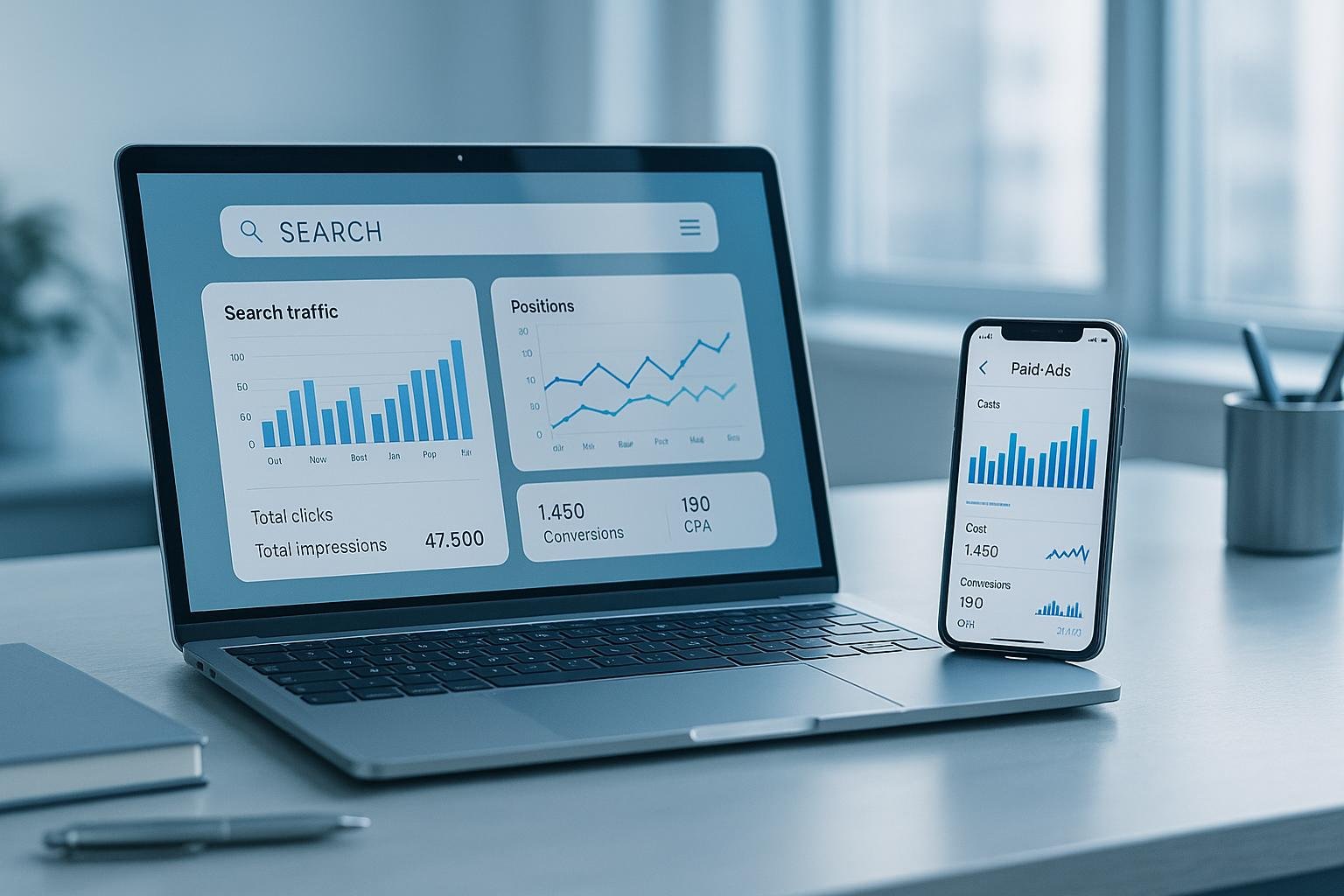
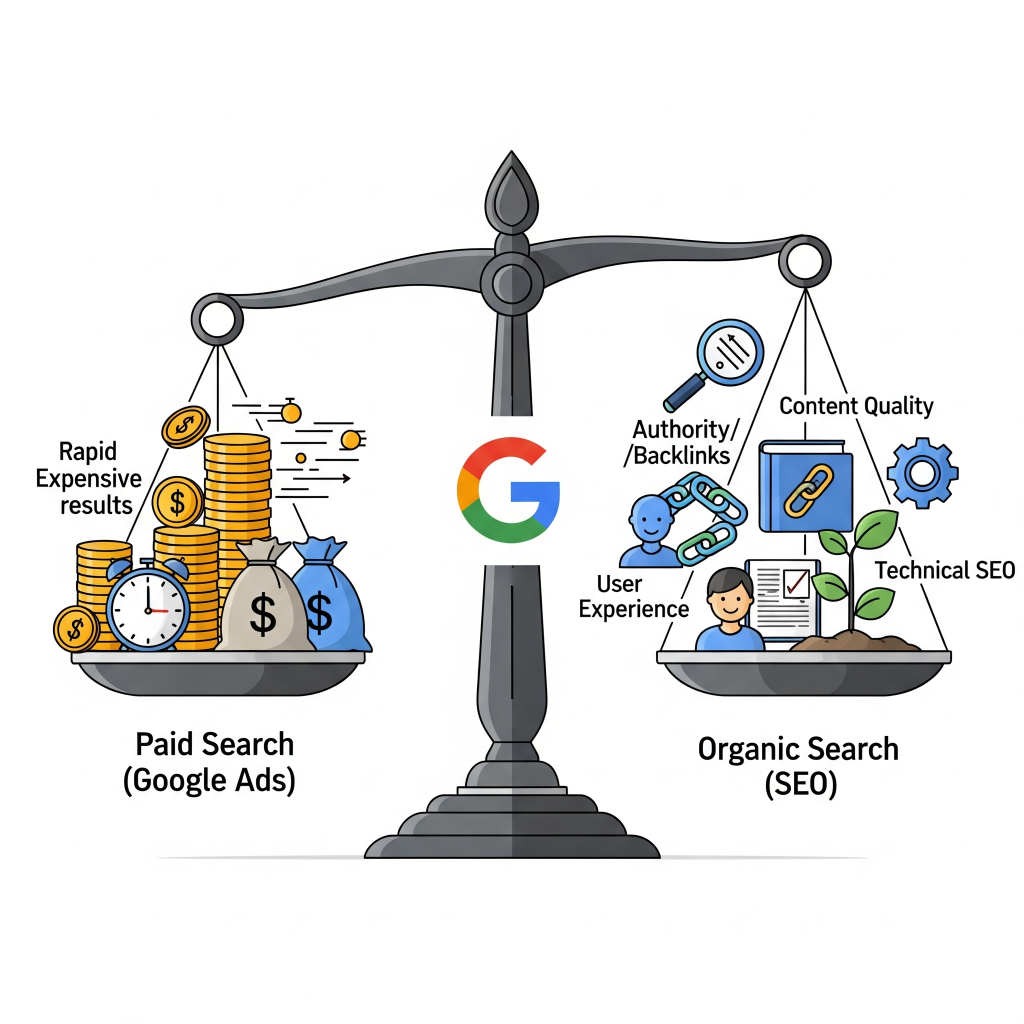
The main difference between these strategies is how businesses gain visibility in search results. SEO focuses on organic rankings, while Google Ads provides access to paid advertising placements.
Here is a comparison of their most important features.
| Comparison Factor | SEO | Google Ads |
| Traffic source | Organic search results | Paid advertising placements |
| Payment model | No direct payment to Google for organic clicks | Depends on campaign bidding and billing settings |
| Time to results | Usually takes time to build visibility | Ads can appear relatively quickly after approval and setup |
| Long-term value | Can generate organic traffic over time | Traffic depends on ongoing campaign eligibility, demand, and budget |
| Main investment | Content, technical optimization, tools, and expertise | Advertising spend, campaign management, and landing pages |
| Targeting | Visibility depends on relevance and organic search performance | Offers paid targeting and campaign controls |
| Best suited for | Long-term organic visibility and content discovery | Faster paid visibility and targeted campaigns |
| Main challenge | Rankings and traffic can take time to develop | Costs can accumulate without profitable conversions |
Neither strategy is universally better. The right choice depends on your goals, budget, competition, website performance, and how quickly you need results.
SEO vs Google Ads: Which Is More Cost-Effective?
Cost-effectiveness depends on the results you achieve relative to the money and time invested.
SEO may require an initial investment in content, technical improvements, and website optimization. However, a successful page can continue attracting organic visitors over time without a direct charge for each click.
Google Ads can generate traffic more quickly, but clicks and conversions may come with ongoing costs. If a campaign attracts visitors who do not become customers, the business may spend its budget without achieving its objectives.
Let’s consider a simple example.
Imagine a business invests ₹20,000 in SEO content and optimization during a month. Its website gradually begins attracting relevant organic visitors. That investment may continue contributing to traffic in subsequent months, although ongoing maintenance and improvements may still be necessary.
Now imagine the same business spends ₹20,000 on Google Ads. The campaign may generate traffic immediately, but its effectiveness depends on how many visitors become qualified leads or paying customers.
These investments cannot be compared fairly by looking at traffic alone. Businesses should also evaluate lead quality, conversion rates, revenue, and the total cost of acquiring customers.
Metrics to Measure SEO Performance
To understand whether your SEO efforts are working, monitor:
- Organic clicks: How many people visit your website from organic search.
- Search impressions: How frequently your pages appear in search results.
- Keyword performance: How your important search queries perform over time.
- Organic conversion rate: The percentage of organic visitors who complete a desired action.
- Cost per organic lead: Your SEO investment divided by the qualified leads generated, using a clearly defined period.
Google Search Console’s Performance report helps website owners analyze search queries, clicks, impressions, and click-through rates. These insights can help you identify pages that need better content or more compelling search snippets.
For a more complete view of visitor behavior and conversions, read LOCAS’s guide on how to use Google Analytics to track website traffic.
Metrics to Measure Google Ads Performance
For paid campaigns, monitor:
- Cost per click (CPC): The average amount paid for each click.
- Click-through rate (CTR): The percentage of ad impressions that result in clicks.
- Conversion rate: The percentage of relevant interactions that result in a desired action.
- Cost per conversion: The advertising cost associated with each tracked conversion.
- Return on ad spend (ROAS): The revenue attributed to advertising relative to advertising expenditure, where revenue tracking is appropriate.
Comparing these metrics helps you identify which channel contributes more effectively to your business objectives.
When Should You Choose SEO?
SEO is a strong option when your business wants to develop organic visibility, publish helpful content, and attract relevant visitors over the long term.
1. You Want Long-Term Organic Traffic
If your business regularly publishes useful articles, service pages, and educational resources, SEO can help those pages attract visitors over time.
For example, a digital marketing institute can publish guides on keyword research, social media marketing, website development, and digital marketing careers. These resources may attract students who are researching courses and career opportunities.
2. Your Audience Researches Before Buying
Many customers compare multiple options before making a purchase or choosing a service. Helpful SEO content can answer their questions and support their decision-making process.
Comparison articles, how-to guides, FAQs, and detailed service pages can help users at different stages of their journey.
3. You Want to Build Industry Authority
Publishing relevant, useful content across connected topics can help establish your website as a valuable resource in your industry.
For example, a website offering digital marketing training can create a content cluster covering SEO basics, keyword research, technical SEO, paid advertising, and analytics.
Relevant internal links can connect these articles and help readers discover additional information. For more on building a digital marketing skill set, readers can explore the LOCAS digital marketing course in Punjab.
4. You Want to Diversify Your Traffic Sources
Depending entirely on paid campaigns can make your traffic vulnerable to changes in advertising costs and budgets.
Building organic visibility provides another way for potential customers to discover your business. Although SEO also requires ongoing attention, it can help diversify your overall marketing strategy.
When Should You Choose Google Ads?
Google Ads can be useful when your business needs faster paid visibility, wants to test demand, or has a specific campaign objective.
1. You Need Leads Quickly
If you are launching a new service or promoting a limited-period offer, Google Ads may help you reach people actively searching for relevant products or services.
For example, a training institute promoting new course admissions can run a focused campaign targeting relevant local searches.
Results depend on campaign setup, competition, budget, and the quality of the landing page.
2. You Have a New Website
A new website may have limited organic visibility because it has not yet established a strong presence in search results.
Google Ads can help bring targeted visitors to your website while you work on content development, technical SEO, and organic growth.
However, paid traffic is only useful when the website provides relevant information and a clear next step for visitors.
3. You Want to Test Offers and Search Demand
Paid search campaigns can help you evaluate which keywords, messages, and offers attract qualified prospects.
For example, a business could test different course-related search terms to identify which campaigns generate relevant inquiries.
Google Ads Keyword Planner can help you discover keyword ideas and review search-volume and bid estimates before creating your campaigns.
Use these findings alongside other research. Good paid campaign performance does not guarantee equivalent organic rankings or traffic.
4. You Are Running a Time-Sensitive Campaign
Google Ads can support seasonal promotions, product launches, enrollment campaigns, and other time-sensitive marketing activities.
Businesses can adjust their campaigns according to their objectives, budget, and performance.
Before launching, make sure you have clear conversion goals, an appropriate budget, and reliable tracking in place.
Can You Use SEO and Google Ads Together?
Yes. Many businesses benefit from using both strategies because they serve different purposes within a broader digital marketing plan.
Instead of treating SEO and paid advertising as competing options, consider how they can complement each other.
Step 1: Use Google Ads to Test Demand
Run targeted campaigns around relevant search terms and monitor the quality of the resulting traffic and leads.
Identify which queries attract people who are genuinely interested in your products or services.
Step 2: Build Relevant SEO Content
Create helpful blog posts, service pages, and educational resources around topics that matter to your audience.
Prioritize content based on search intent, business value, competition, and the needs of potential customers.
Step 3: Improve Your Landing Pages
Use insights from both channels to improve page relevance, messaging, navigation, and calls to action.
A clear landing page can help visitors understand your offer and decide what to do next. For additional ideas, see LOCAS’s article on website layout best practices for higher conversions.
Step 4: Track Leads and Conversions
Use suitable analytics and conversion tracking to understand how visitors interact with your website.
Remember that an advertising platform may attribute a conversion to an ad without proving that the ad caused the conversion. Consider the wider customer journey when evaluating results.
Step 5: Review Performance and Adjust Your Budget
Compare channel performance using consistent definitions of qualified leads, sales, and revenue.
Continue investing in the activities that contribute to your business goals, and review the results regularly.
For example, LOCAS can use Google Ads to promote its digital marketing courses while publishing SEO-focused articles about marketing skills, career opportunities, keyword research, and website optimization.
Paid campaigns can support immediate enrollment objectives, while organic content can help prospective students discover the institute as they research their options.
Common Mistakes to Avoid
Whether you invest in SEO, Google Ads, or both, avoid these common mistakes.
- Expecting instant SEO results: Organic visibility usually takes time to develop.
- Running ads without conversion tracking: Clicks do not necessarily translate into business results.
- Targeting irrelevant keywords: Unqualified traffic can waste time and marketing resources.
- Ignoring landing page quality: Confusing messaging or a poor user experience can reduce conversions.
- Comparing different metrics: Evaluate channels using consistent business outcomes rather than traffic volume alone.
- Stopping SEO after initial improvements: Content quality, technical performance, and organic visibility need ongoing monitoring.
- Assuming paid advertising guarantees sales: Campaign performance also depends on the offer, audience, website, pricing, and sales process.
A successful marketing strategy focuses on attracting the right audience and turning relevant visits into meaningful business outcomes.
SEO vs Google Ads: Which One Should You Choose?
The right choice depends on your business priorities, resources, and timeline.
Choose SEO if:
- You want to build organic visibility over time.
- Your audience searches for educational or informational content.
- You want to develop a sustainable source of website traffic.
- You can invest in useful content and ongoing optimization.
Choose Google Ads if:
- You need faster paid visibility.
- You are promoting a specific offer or service.
- You want to test search demand and campaign messaging.
- You have a budget and can measure campaign performance.
Choose both if:
- You want to pursue short-term opportunities while building long-term visibility.
- You have the resources to manage both channels effectively.
- You want to diversify traffic sources and compare their contribution to business results.
For businesses with limited budgets, start by identifying your target audience, the value of a qualified lead, and the time available to achieve your goals. Then select a channel that you can manage and measure effectively.
Conclusion
Understanding SEO vs Google Ads helps businesses make informed decisions about their digital marketing investments.
SEO can help build organic visibility and attract relevant visitors over time, while Google Ads can provide faster access to paid search placements and support targeted campaigns.
Neither strategy guarantees results. Both require clear objectives, relevant landing pages, ongoing optimization, and reliable measurement.
For many businesses, the strongest approach is to align both channels with their marketing goals, monitor qualified leads and revenue, and adjust their investment according to performance.
Want to develop practical skills in SEO, Google Ads, and other digital marketing channels? Explore the digital marketing training programs at LOCAS and learn how these strategies can be applied to real-world marketing projects.
Frequently Asked Questions
1. What is the main difference between SEO and Google Ads?
SEO focuses on improving a website’s visibility in organic search results. Google Ads allows businesses to promote their offerings through paid advertising placements. SEO generally takes time to build, while eligible ads can begin appearing after campaign approval and setup.
2. Is SEO cheaper than Google Ads?
SEO does not require a direct payment to Google for each organic click, but it involves investment in content, tools, technical improvements and expertise. Google Ads involves advertising expenditure and may also require campaign management and landing page development. The more cost-effective option depends on the value of the results generated.
3. How long does SEO take to show results?
SEO timelines vary depending on competition, website condition, content quality, and other factors. Meaningful improvements often take months, and no specific ranking or timeframe is guaranteed.
4. Can Google Ads improve organic SEO rankings?
Paying for Google Ads does not directly improve organic search rankings. However, paid advertising and SEO can complement each other as part of a broader digital marketing strategy.
5. Should a small business invest in SEO or Google Ads first?
A small business should consider its budget, urgency, competition, and ability to convert visitors into customers. Google Ads may suit an immediate campaign, while SEO can support long-term organic visibility. A focused combination may work when resources allow.
6. Can I run SEO and Google Ads at the same time?
Yes. You can use Google Ads to reach potential customers through paid placements while investing in SEO to improve organic visibility. Track each channel carefully and evaluate its contribution to qualified leads and revenue.
7. Which is better for lead generation: SEO or Google Ads?
Both can generate leads. Google Ads may help reach users with immediate intent, while SEO can attract people at different stages of their research. Lead quality, conversion rate, acquisition cost, and revenue are more useful decision criteria than traffic volume alone.