In the modern digital landscape, real-time communication is no longer a luxury—it’s an expectation. Businesses and educational platforms, including top institutions like Locas Institute in Ludhiana, are constantly looking for ways to enhance user engagement and provide instant support. This is where a React & Node.js Chatbot shines.
This powerful combination of technologies allows you to build a fast, scalable, and interactive conversational interface. React.js, with its component-based architecture and Virtual DOM, makes the front-end interface snappy and highly responsive to new messages. Node.js, with its non-blocking, event-driven nature, is perfectly suited for handling the high volume of simultaneous connections needed for a real-time chat application.
Key Benefits of the React and Node.js Stack for Chatbots:
- Real-Time Performance: Node.js’s efficiency, often paired with Socket.IO (a key LSI keyword), ensures messages are delivered instantly.
- Scalability: Node.js can handle numerous concurrent users, making it ideal for growing platforms.
- Unified Language: Using JavaScript on both the front-end (React) and the back-end (Node.js) streamlines development and simplifies hiring.
- Rich User Experience: React’s component model enables the creation of complex, visually appealing, and intuitive chat interfaces.
The Essential Toolkit: Prerequisites for Development
Before diving into the code, ensure you have the foundational tools for chatbot development.
- Node.js and npm (or yarn): Essential for running the backend server and managing project dependencies.
- Basic JavaScript Knowledge: A solid understanding of ES6+ features, promises, and asynchronous programming is crucial.
- React Fundamentals: Familiarity with components, state management (like
useStateanduseEffect), and props. - Express.js: The fast, minimalist web framework for Node.js, used to build the backend REST API.
- Socket.IO: The definitive library for enabling WebSockets and real-time bidirectional communication between the client and server.
Step-by-Step Guide: Building Your Real-Time Chatbot
Developing a React & Node.js Chatbot involves two major parts: the user interface (Frontend) and the communication engine (Backend).
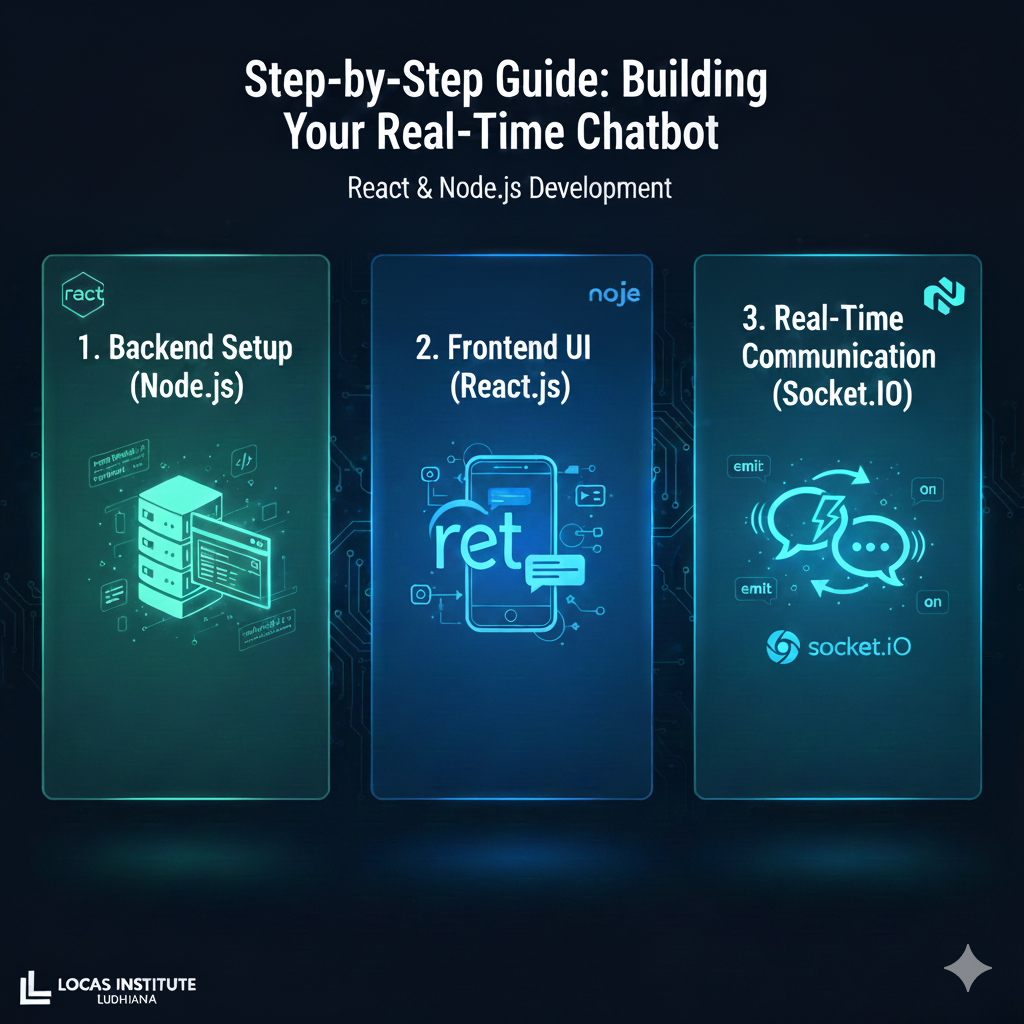
1. Setting Up the Backend with Node.js and Express
The Node.js server will handle user requests, manage the WebSocket connection, and potentially interact with a database (like MongoDB or MySQL – great LSI keywords) for conversation history.
- Project Initialization: Create a new folder and run
npm init -y. - Install Dependencies: Install
express,socket.io, andcorsto allow communication from your React app.npm install express socket.io cors - Server Setup (
server.js): Create a basic Express server and integrate Socket.IO. The server listens for specific events, such as a user connecting or sending a message.
const express = require('express');
const http = require('http');
const { Server } = require('socket.io');

const app = express();
const server = http.createServer(app);
// Initialize Socket.IO
const io = new Server(server, { cors: { origin: "http://localhost:3000" } });

io.on('connection', (socket) => {
    console.log(`User Connected: ${socket.id}`);
    // Listen for incoming messages
    socket.on('send_message', (data) => {
        // Broadcast the message to all other users in the room
        socket.to(data.room).emit('receive_message', data);
    });
});

server.listen(3001, () => {
    console.log("SERVER RUNNING");
});
2. Creating the Frontend with React.js
The React application provides the user interface for the chat. It will connect to the Node.js server using the Socket.IO client library.
- Project Initialization: Use a tool like Create React App or Vite to quickly set up your project.
npx create-react-app chatbot-frontend - Install Dependencies: Install the client-side Socket.IO library.
npm install socket.io-client - Chat Component (
Chat.js):- Establish Connection: Use
socket.io-clientto connect to your Node.js server. - Manage State: Use React Hooks (
useStateanduseEffect) to manage the list of messages in the chat window. - Send/Receive Logic: The component should emit a
send_messageevent when a user types and clicks send. It must also listen for thereceive_messageevent from the server to instantly display new messages.
- Establish Connection: Use
3. Implementing Real-Time Communication with Socket.IO
The true real-time development magic happens here. Socket.IO abstracts the complexity of WebSockets for a smooth bidirectional connection.
- When a user sends a message in the React app, the client emits a
send_messageevent to the Node.js server. - The Node.js server receives this event and uses
socket.to(room).emit('receive_message', data)to instantly send the message back to all other connected clients in that specific chat room. - The receiving React clients listen for the
receive_messageevent and update their message state, causing a re-render and displaying the new message instantly—no page refresh required!
Enhancing Your Chatbot (Advanced Topics)
To take your chatbot project from a simple messenger to a professional-grade application, consider these advanced concepts:
- Integrating an AI Service: Connect your Node.js backend to a Natural Language Processing (NLP) service like Dialogflow or the OpenAI API (another strong LSI keyword) to process user input and generate intelligent, conversational responses.
- User Authentication: Implement secure authentication (e.g., JWT with Express) to ensure only authorized users can access the chat rooms and conversations.
- Database Integration: Use a database like MongoDB or PostgreSQL to store conversation history and user profiles. This is crucial for maintaining context across sessions.
Kickstart Your Full-Stack Career at Locas Institute, Ludhiana
Ready to stop reading and start building? Mastering the React & Node.js stack is the fastest way to become a high-demand Full Stack Developer.
At Locas Institute, located conveniently in Ludhiana, we offer expert-led Full Stack Development Courses that dive deep into React.js, Node.js, and real-time development technologies like Socket.IO. Our hands-on training ensures you gain the practical skills needed to build powerful applications, including your own scalable real-time chatbot.
Don’t just learn theory; build projects that matter. Join Locas Institute today and transform your coding skills into a rewarding career in web development.
React & Node.js Chatbot FAQs
1. Is React and Node.js a good stack for a real-time application like a chatbot?
A: Absolutely. Node.js’s event-driven architecture is excellent for handling many concurrent connections, which is vital for real-time applications. React.js provides a highly efficient and fast user interface layer, making the combination—often referred to as a portion of the MERN stack—a top choice for building a scalable real-time chatbot.
2. What is the main tool used for real-time communication between React and Node.js?
A: The primary tool for achieving real-time communication is Socket.IO. It uses the WebSocket protocol to establish a persistent, bidirectional connection between the React client and the Node.js server, allowing data (like chat messages) to be sent instantly without constant polling.
3. Do I need to know a database for building a React and Node.js chatbot?
A: Yes, for any practical chatbot development that saves conversation history or user profiles, you will need a database. Popular choices for this stack include MongoDB (forming the MERN stack) or a relational database like PostgreSQL or MySQL.
Q4: How can I make my chatbot intelligent and not just a simple messenger?
A: To create an AI-powered chatbot, you need to integrate a Natural Language Processing (NLP) service. The Node.js backend can be configured to make API calls to services like the OpenAI API or Google’s Dialogflow to process the user’s message, understand their intent, and generate a sophisticated response before sending it back to the React frontend.
5. Where can I learn Full Stack Development with React and Node.js in Ludhiana?
A: You can master the entire React and Node.js stack, including chatbot development and other full-stack projects, by enrolling in the comprehensive development courses offered by Locas Institute in Ludhiana. They provide practical, job-oriented training on these in-demand technologies.