If you run a business today, you’ve probably asked yourself this question at least once: “Should I put my money into digital marketing, or stick with traditional methods like newspaper ads and banners?”
It’s a fair question, and honestly, there’s no one-size-fits-all answer. Both digital and traditional marketing have their own strengths, weaknesses, and ideal use cases. In this blog, we’ll break down both approaches in detail, compare them side by side, and help you figure out which one (or what combination) is right for your business.
What Is Traditional Marketing?
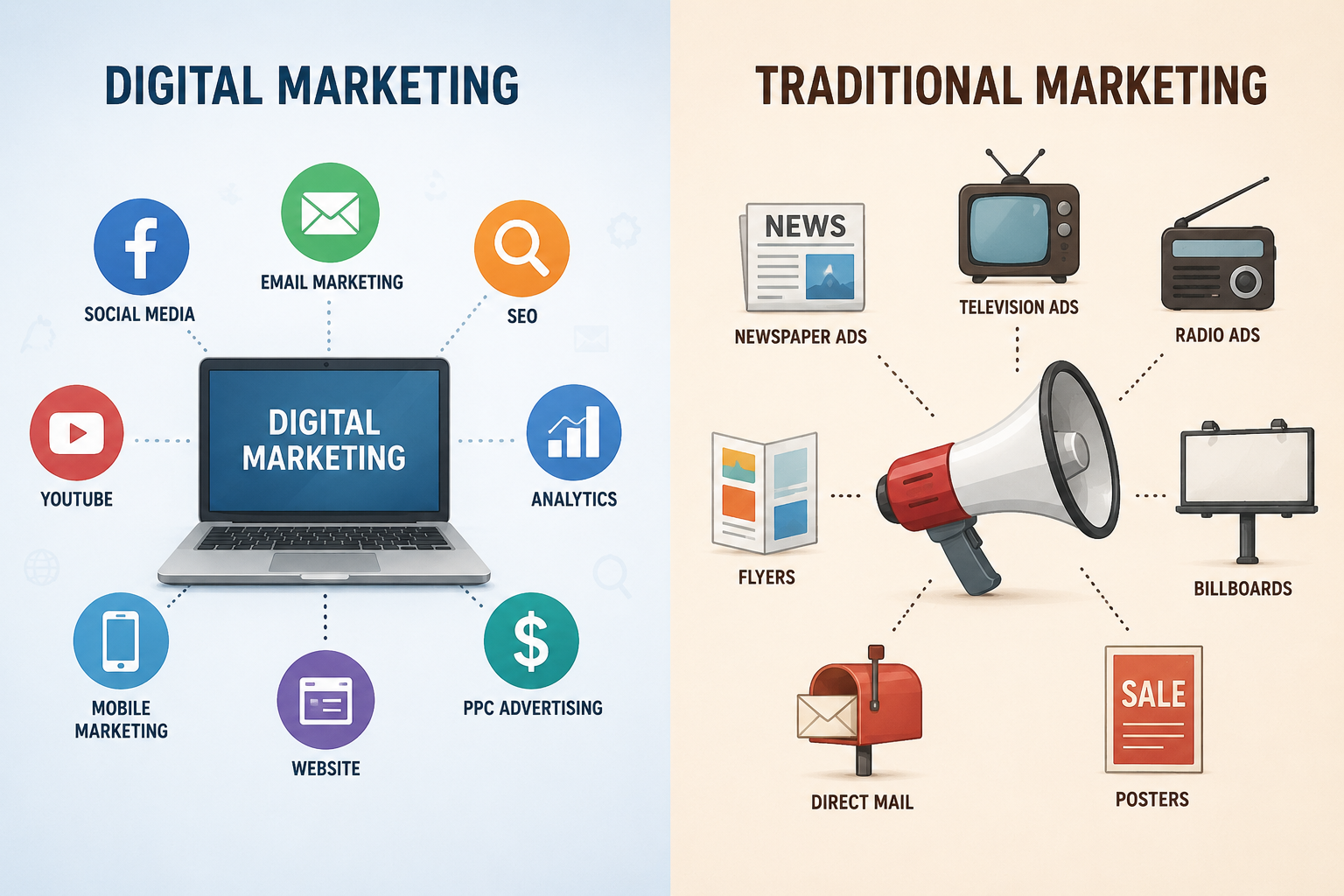
Traditional marketing refers to the marketing methods that have been around for decades, long before the internet became a part of everyday life. This includes:
- Broadcast media – television and radio advertisements
- Outdoor advertising – billboards, banners, hoardings
- Direct mail – postcards, catalogs sent to homes
- Word of mouth and in-person networking
- Print media – newspapers, magazines, brochures, flyers
These methods rely on reaching a broad, often local, audience through physical or offline channels.
What Is Digital Marketing?
Digital marketing, on the other hand, refers to any marketing effort that uses the internet or electronic devices. This includes:
- Social media marketing – Instagram, Facebook, YouTube, LinkedIn
- Search Engine Optimization (SEO) – ranking higher on Google
- Content marketing – blogs, videos, infographics
- Email marketing – newsletters, promotional emails
- Pay-per-click (PPC) advertising – Google Ads, Meta Ads
- Influencer marketing – collaborating with online creators
Digital marketing allows businesses to reach highly specific audiences based on their interests, location, age, and online behavior.
Differences Between Digital and Traditional Marketing
1. Cost
Traditional marketing tends to be expensive. A single television ad or a full-page newspaper advertisement can cost lakhs of rupees, and there’s no guarantee it will reach the right audience.
Digital marketing, in comparison, is far more budget friendly. You can start a social media campaign or run Google Ads with as little as a few hundred rupees a day, making it accessible even for small businesses and startups.
2. Audience Targeting
This is where digital marketing truly shines. Platforms like Facebook and Google allow you to target people based on age, location, gender, interests, and even past browsing behavior. This means your ad reaches people who are actually likely to buy from you.
Traditional marketing, however, is more like shouting into a crowd — you’re paying to reach everyone, whether or not they’re interested in your product.
3. Measuring Results
With digital marketing, you can track everything in real time: how many people saw your ad, clicked on it, and made a purchase. Tools like Google Analytics and Meta Ads Manager give you detailed insights into your campaign’s performance.
Traditional marketing lacks this precision. It’s very difficult to know exactly how many people saw a billboard or read a newspaper ad and then decided to visit your store.
Reach and Trust
That said, traditional marketing still has an edge in certain areas. Many people, especially older generations, trust a brand more if they’ve seen it on television or in a local newspaper. There’s also something powerful about physical presence — a well-placed hoarding in a busy market can create strong local brand recall.
Digital ads, especially poorly targeted ones, can sometimes feel intrusive or be ignored altogether (banner blindness is a real thing).
5. Speed and Flexibility
Digital marketing campaigns can be created, launched, tested, and modified within hours. If an ad isn’t performing well, you can pause it and try a new approach immediately.
Traditional marketing takes much longer to plan and execute. Printing materials, booking ad slots, and distributing flyers all take time, and once it’s out there, you can’t easily change it.

When Should You Use Traditional Marketing?
Traditional marketing still makes sense in specific situations:
– You’re targeting a **local, older demographic** that may not be very active online
– You want to build **long-term brand trust** in your local community
– Your business benefits from **strong physical visibility** (like a showroom or storefront)
– You have the budget to invest in large-scale brand awareness campaigns
When Should You Use Digital Marketing?
Digital marketing is ideal when:
– You’re a **small or medium business** with a limited budget
– You want **measurable, trackable results**
– Your target audience is **active on social media or search engines**
– You want to build an **online brand presence** and generate leads consistently
– You need the flexibility to **test and improve** your campaigns quickly